Linked List Cycle (Leetcode #141)
I am a beginner coder who wants to keep track of my coding progress. I will post my LeetCode solutions here. Please feel free to give me advice or suggestions on my code.
Also, in the future, I will be posing my data science-related project here as well
Given head, the head of a linked list, determine if the linked list has a cycle in it.
There is a cycle in a linked list if there is some node in the list that can be reached again by continuously following the next pointer. Internally, pos is used to denote the index of the node that tail's next pointer is connected to. Note that pos is not passed as a parameter.
Return true if there is a cycle in the linked list. Otherwise, return false.
Example 1:
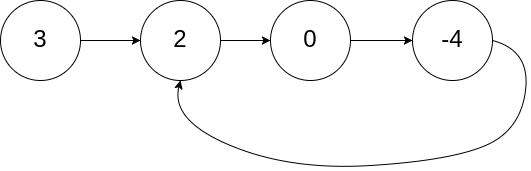
Input: head = [3,2,0,-4], pos = 1
Output: true
Explanation: There is a cycle in the linked list, where the tail connects to the 1st node (0-indexed).
Example 2:
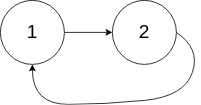
Input: head = [1,2], pos = 0
Output: true
Explanation: There is a cycle in the linked list, where the tail connects to the 0th node.
Example 3:

Input: head = [1], pos = -1
Output: false
Explanation: There is no cycle in the linked list.
Constraints:
The number of the nodes in the list is in the range
[0, 10<sup>4</sup>].-10<sup>5</sup> <= Node.val <= 10<sup>5</sup>
Follow up: Can you solve it using O(1) (i.e. constant) memory?
Answer
Since the question requires us to solve it with constant space complexity, we need to use pointers.
This problem can be solved with a two-pointer approach. We'll use a fast pointer and a slow pointer. The fast pointer will move twice as fast as the slow pointer. If the fast pointer reaches the end of the list, there is no cycle. However, if the fast pointer meets the slow pointer at any point, we know there is a cycle in the list.
# Definition for singly-linked list.
# class ListNode(object):
#     def __init__(self, x):
#         self.val = x
#         self.next = None

class Solution(object):
    def hasCycle(self, head):
        """
        :type head: ListNode
        :rtype: bool
        """
        if not head:
            return False
        fast = head.next
        slow = head
        while fast and fast.next:
            fast = fast.next.next
            slow = slow.next
            if fast == slow:
                return True

        return False
Time complexity O(N). In the worst case two pointer will traverse the list ounce hence the overall time complexity is O(N)
Space Complexity O(1). Since its only pointers the space complexity is O(1)